





In this article, I'd like to discuss how to identify the core question and argument for a research article.
The previous article is below:

Regarding the process of writing a research article, I believe the first thing to do is narrow down the central question and the argument that answers it. Some academic writing books suggest starting with the introduction, but I disagree.
The first thing to do is identify the main argument
The purpose of a research article today is to convey a clear argument to readers. In the past, research articles were more descriptive, recording the process of research and presenting data in the order they were found. But this style no longer serves today's readers well. With millions of articles published each year — PubMed alone indexes over one million annually — no researcher can afford to read every paper from beginning to end. We need to identify the main argument of a research project upfront and ensure that this message is coherent across all sections.
A famous example that illustrates this point is Mendel's Experiments on Plant Hybridization (English translated version). Interestingly, this paper mostly follows the IMRAD structure we use today: it reviews previous studies, explains methods, then describes results and discussion. The key difference, however, is that it does not present its main argument, the law of segregation and independent assortment, until the middle of the paper. The Introductory Remarks merely state that "detailed experiments" are needed, without previewing what was actually discovered. In a modern paper, this core finding would appear in the abstract and at the end of the introduction. In fact, Mendel's groundbreaking work was largely ignored for over 30 years. While there were many reasons for this, the buried presentation of his central argument may well have contributed to the neglect.
This historical example highlights a principle that is even more critical today. Many readers now scan articles or use LLMs to summarise papers because they simply don't have time to read everything. Your main message should be crystal clear from the very beginning. If an LLM summarises a paper whose main argument is buried in the middle, the summary may miss or distort the most important point, just as human readers might stop reading before they reach it. So before you start writing, identify your main argument first and make sure it is visible from the opening sections of your paper.
Gathering and organising the building blocks with LLM assistance
To build a strong main argument, we need to go through several steps: choose the relevant facts from previous studies and our own results, find the relationships between them, build a knowledge network, and finally, find a clear path through that network to tell the story in a logical order. Here, "main argument" does not mean just the conclusion. It refers to the logical narrative that runs through your paper: what question you asked, why it matters, what you found, and what it means beyond your own study. In this section, I will walk through each of these steps.
The first step, choosing the facts, may sound like cherry picking, one of the most criticised practices in scientific writing. But what I mean here is fundamentally different. Cherry picking selects only the facts that support a desired conclusion while ignoring inconvenient evidence. What we need to do instead is select the facts that are relevant to the argument, both supporting and opposing, in order to refine it into something more sophisticated and specific. This includes identifying the limitations of the argument and connecting it to the next research question. The goal is not to make the argument look strong by hiding weaknesses, but to make it genuinely strong by acknowledging and addressing them.
So, where do the facts come from? One way is to search for relevant evidence using the AI research tools I introduced in a previous article.

Many of these tools now have semantic search, so you can simply ask questions in natural language. Once you have gathered relevant findings, keep them organised and ready to use before you start writing. I personally use Zotero and Obsidian for this purpose.

LLM Tip 1 — Extract findings, but interpret them yourself
Extracting key findings from a paper is now straightforward; LLMs can do it reliably. What LLMs cannot do as well is interpret those findings in the context of your specific research. So when reading each article, focus on jotting down how the findings relate to your own work, rather than just summarising the paper itself. This will make the later steps much easier.
Once you have gathered the relevant facts, organise them and their relationships systematically. How you organise depends on your preference and the scale of the project. There are many ways to do this: outlines, mind maps, concept maps, and so on. If the project is relatively small and the relationships are clear in your mind, a simple outline may be enough. It translates directly into the paragraph structure of your article. For more complex projects where you need to untangle relationships among many results and previous studies, a visual approach works better.
LLM Tip 2 — Use LLM-generated mind maps as a starting point
A mind map is useful for both generating and organising ideas, and many LLM-based tools already offer this format. For example, Google NotebookLM can generate a mind map to summarise your sources.
You can also combine an LLM-generated mind map with one you have drawn yourself. As with the overall approach in this article, treat LLM outputs as drafts or starting points, and build on them with your own thinking.

Another option is a concept map, which looks similar to a mind map but has one crucial difference: each connection between concepts is labelled with a verb or phrase that makes the relationship explicit.
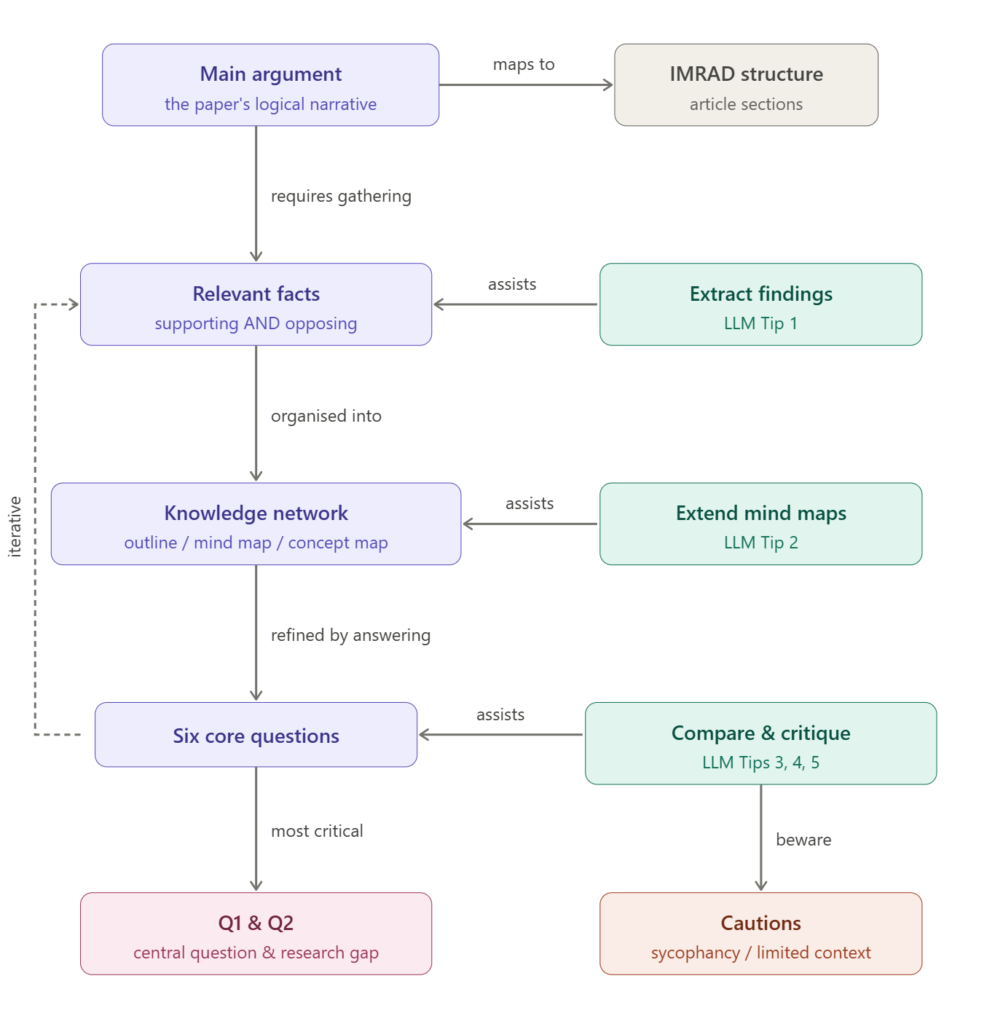
This forces you to articulate how concepts relate to each other, rather than leaving the connections vague. This clarity becomes especially valuable in the next step, where we use LLMs to help structure the argument. Clearly defined relationships provide much more accurate context than vague connections.
Refining the argument with LLMs
Now that we have a concept network, how do we use LLMs to refine it into a coherent main argument? First things first: we need a goal. The following list presents the core questions to answer when writing a research article, cited from the book The Scientist's Guide to Writing:
- What is the central question?
- Why is this question important?
- What data (variables) are needed to answer this question?
- What methods are used to get those data?
- What analysis must be applied for the data to answer the central question?
- What data (values) were obtained?
- What were the results of the analyses?
- How did the analyses answer the central question?
- What does this answer tell us about the broader field?
Answering each question clarifies the core content of a research article, and each one aligns with a section of the IMRAD structure. When we focus specifically on building the main argument, six of these questions are particularly important. The remaining three (Q4, Q5, Q6) are either already determined by the time we sit down to write — because the experiments are done — or they follow automatically once the other six are in place. We answer the six by looking at our concept network:
- What is the central question?
- Why is this question important?
- What data (variables) are needed to answer this question?
- What were the results of the analyses?
- How did the analyses answer the central question?
- What does this answer tell us about the broader field?
Among these, Q1 and Q2 are especially important. Q2 corresponds to the research gap and the significance of your study — and these essentially decide the fate of the entire article. I'm currently struggling to publish an article myself: my research is multidisciplinary, but I framed the central question in a way that leaned too heavily on the significance for just one of the fields involved. This made the article less compelling to reviewers from other disciplines. In hindsight, I should have thought more carefully about how the question's importance would land across all the fields my work touches.
Several AI tools can help you identify research gaps, such as Scispace, AnswerThis, and Jenni AI. They are useful for spotting gaps, and general-purpose LLMs like ChatGPT, Gemini, and Claude can also help through their deep research features. However, none of them can fully account for your specific situation. For example, even if a research gap exists, you may not be able to bridge it — maybe you can't obtain the required data, you lack access to the necessary equipment, or you simply don't have the budget. I've also found that their suggestions are sometimes theoretically flawed or based on a narrow slice of the literature. So you shouldn't rely on LLMs alone. We need to combine our own constraints and domain knowledge with the insights LLMs provide to find meaningful gaps and articulate their significance.
When you first select a central question and its answer from the concept network, you often realise that some additional data are needed to support it. This is an important advantage of this approach: you can search again, check whether your central question and answer hold up, and then rebuild the network. This process is iterative rather than linear. We revisit and revise rather than march straight through.
LLM Tip 3 — Compare your answers with LLM-generated ones
LLMs are especially helpful in this iterative process. When we settle on a central question and its answer, it's hard to see alternative options on our own. But when you organise your central question, answer, and supporting results for an LLM, you start to notice other perspectives or problems you hadn't considered. This is similar to a common experience: explaining your opinion to someone else helps you organise your own thinking and prompts you to reconsider. Articulating your core question and discussing it with an LLM works the same way — it surfaces aspects of the question you might have missed.
Concretely, after writing your own answers to the six questions, ask an LLM to answer the same questions using the same context (your summarised results and data). Compare the two sets of answers, weigh their strengths and weaknesses, and incorporate the good ideas into your own answers. This will make your argument more robust.
Revisiting these six questions is essential for maintaining a coherent argument. When I once wrote a research article quickly in one sitting and submitted it, a reviewer harshly pointed out that the supporting data for the main argument were far too weak, and that most of the evidence in the article actually supported other, less important claims. Naturally, the article was rejected. This taught me that reconfirming the alignment between the main argument and its supporting data is something we need to do throughout the entire writing process, not just at the end.
LLM Tip 4 — Use LLMs as disciplinary critics
Using LLMs as critics and discussing the core question at least once can help prevent this kind of problem. To get useful criticism, providing context in the prompt is key. Start by assigning a specific role — for example: "You are a theoretical physicist and an editor of a theoretical physics journal. From that perspective, criticise the main argument and the evidence supporting it."
Without a clear grasp of the main argument, we also tend to produce redundant content. I frequently saw the word "redundancy" in reviewer comments, especially when I was first starting to write research articles — and honestly, it still comes up. This problem has both a grammatical side and a content side, but here I focus on the content.
LLM Tip 5 — Let LLMs rank your evidence by relevance
If you have a well-built concept network, LLMs can also help you trim unnecessary content. Provide the central question and its answer along with your summarised interpretations of the data, then ask: "Select the interpretations that are relevant to answering the central question, and rank them in order of priority with reasons." Review the output and decide what to keep and what to drop.
Cautions when using LLMs in this process
There are several things to watch out for when using LLMs in this way.
First, getting criticism is essential for spotting problems in your article. But sycophancy in LLMs has become a well-known issue. LLMs tend to agree with you too readily, because they are commercial products designed to keep users satisfied and paying. Reassurance is incredibly tempting when you're going through something as stressful and exhausting as writing and submitting a research article. But that sweet talk can lead to a harsh outcome: rejection. So you need to craft your prompts in a way that explicitly asks the LLM to identify weaknesses in your main argument. If an LLM says something like "This paragraph is logically clear and well-grounded," don't believe it until the article is accepted.
Second, although LLMs often provide concrete suggestions for improvement, following them uncritically carries its own risks. A research article involves a vast amount of context — not just data and previous studies, but also constraints like laboratory equipment, budget, data accessibility, and time limitations. We can't feed all of this into a prompt, and if a conversation goes on too long, the accumulated context can start to confuse the LLM. Hallucinations become more likely after extended discussions. We should always keep these limitations in mind.
Summary
To write a research article, start by identifying your main argument, then gather relevant facts and organise their relationships using outlines, mind maps, or concept maps. Refine the argument by answering six core questions, iterating as needed. LLMs can support each stage: extracting findings from papers, generating or expanding outlines and mind maps, critiquing your argument from a specific disciplinary perspective, and ranking your evidence to cut redundancy. But always interpret and decide yourself — LLMs tend toward sycophancy and lack your full research context.

コメント